
Shopify is often associated with launching an online store quickly. For small and medium-sized businesses, that may be exactly what is required.
Enterprise commerce is different.
A large organization may already have an ERP, CRM, PIM, warehouse management system, payment infrastructure, analytics platforms, marketing tools, marketplaces, physical stores, B2B customers and operations across multiple countries.
In this environment, the question is no longer:
How do we build a Shopify store?
The better question is:
How should Shopify fit into the complete enterprise commerce ecosystem?
This is where a Shopify Plus enterprise architecture approach becomes important.
Shopify as the Commerce Layer, Not the Entire Business System
One of the most important architectural decisions is understanding what Shopify should-and should not-be responsible for.
Consider a large organization selling through multiple channels.
Its technology ecosystem could include:
- Shopify Plus for digital commerce
- SAP or another ERP for finance, inventory and operations
- PIM/DAM for product information and digital assets
- CRM/CDP for customer information and engagement
- OMS/WMS for order fulfilment and warehouse operations
- Payment gateways and fraud-management systems
- Marketing and analytics platforms
- Marketplaces and retail/POS channels
- Business intelligence and data warehouse platforms
Trying to replace all these systems with Shopify would usually be the wrong architectural approach.
Instead, Shopify becomes a commerce platform connected to the wider enterprise ecosystem.
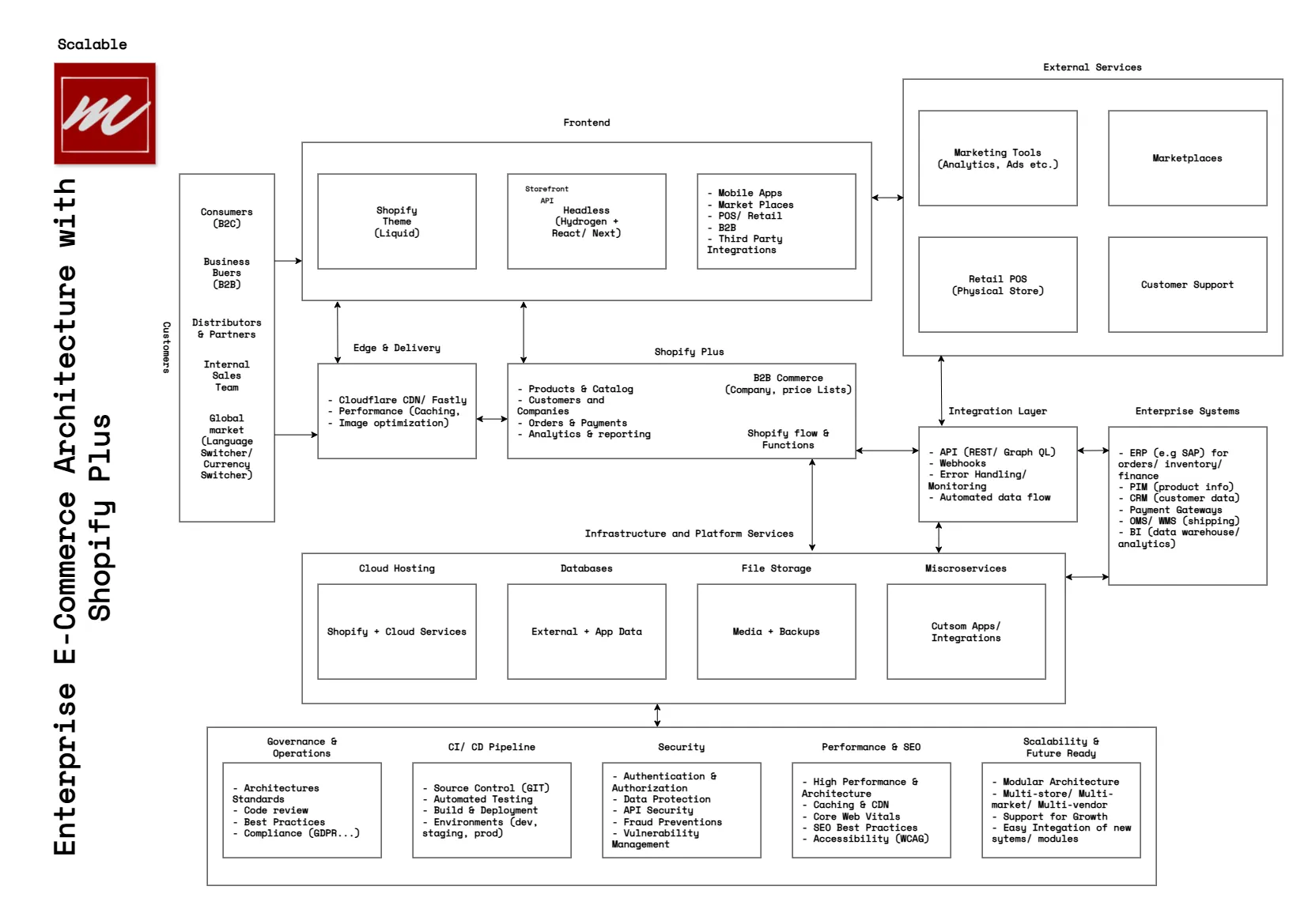
Reference Shopify Plus Enterprise Architecture
A scalable architecture can be divided into several layers.
Customers and Markets
The architecture starts with the people and organizations interacting with the commerce platform.
These may include:
B2C customers purchasing products directly.
B2B buyers purchasing on behalf of companies.
Distributors and partners requiring specialized catalogs, pricing or purchasing processes.
Internal sales teams assisting customers or managing accounts.
Global markets requiring different languages, currencies, domains, pricing and regional experiences.
The storefront should therefore be designed around more than a single customer journey.
Frontend and Customer Experience
There are several ways to build the customer-facing experience.
Shopify Liquid
For many commerce projects, Shopify’s traditional theme architecture remains an excellent solution.
A custom Liquid storefront can provide:
- responsive design
- custom sections and components
- accessibility
- SEO-friendly pages
- localized experiences
- fast development
- relatively low infrastructure complexity
Headless architecture should not automatically be selected simply because it is considered more modern.
Architecture should follow the business requirement.
Hydrogen + React
For more complex requirements, Shopify can operate as a headless commerce backend.
A frontend built with Hydrogen and React can communicate with Shopify using the Storefront API.
This can be useful when an organization requires:
- highly customized customer experiences
- content from multiple platforms
- advanced personalization
- multiple frontend channels
- custom mobile experiences
- integration with a headless CMS
- composable commerce architecture
The trade-off is additional technical and operational complexity.
The organization now owns more of the frontend hosting, deployment, caching, monitoring and integration architecture.
Shopify Plus as the Commerce Core
At the center of the architecture sits Shopify Plus.
It can manage important commerce capabilities such as:
Products and Catalog
Products, variants, collections and commerce-specific product configuration.
Customers and Companies
Customer accounts and B2B company relationships.
Orders and Payments
The transactional commerce lifecycle from checkout through order creation.
Checkout Extensibility
Enterprise checkout requirements should use Shopify’s supported extensibility architecture rather than fragile checkout modifications.
Shopify Functions
Functions can introduce custom commerce logic within supported Shopify capabilities.
Shopify Flow
Flow can automate business processes and reduce the need for custom applications for straightforward workflow requirements.
B2B Commerce
Enterprise implementations may also require company accounts, catalogs, buyer permissions and business-specific purchasing experiences.
The architectural objective should always be to use native Shopify functionality where it makes sense and introduce custom development only where it adds genuine value.
The Integration Layer
For me, this is one of the most important parts of enterprise Shopify architecture.
Shopify rarely works alone.
An integration layer may sit between Shopify and enterprise systems.
It can handle:
- REST and GraphQL APIs
- Shopify Admin API
- Storefront API
- webhooks
- message queues
- event buses
- data transformation
- middleware or iPaaS
- retries
- error handling
- logging and monitoring
Instead of tightly connecting every system directly to every other system, an integration architecture provides controlled communication between platforms.
Shopify + ERP Integration
Consider a business using an ERP such as SAP.
A customer may purchase something through Shopify:
Customer → Shopify Storefront → Checkout → Shopify Order
But creating the Shopify order may only be the beginning.
The order could then need to reach:
Shopify → Integration Layer → ERP
The ERP may subsequently coordinate inventory, accounting, fulfilment or other operational processes.
Information may then travel in the opposite direction:
ERP / WMS → Integration Layer → Shopify → Customer
For example, Shopify may receive updated fulfilment or inventory information.
This is why enterprise Shopify development is significantly different from simply developing a theme.
Product Information Management
Large catalogs can introduce another architectural consideration.
An organization may use a dedicated PIM - Product Information Management system.
The PIM could be responsible for enriched product information such as:
- product attributes
- specifications
- descriptions
- categories
- localization
- digital assets
- product relationships
The architecture might therefore look like:
ERP → PIM → Shopify
or another variation depending on which system owns each type of information.
There is no universal answer.
The important architectural question is:
Which system is the source of truth for this data?
CRM and Customer Data
Shopify may collect customer and transactional information, while the organization uses a CRM or CDP for broader customer engagement.
Customer events could therefore flow between:
Shopify ↔ Integration Layer ↔ CRM/CDP
This can support activities such as customer service, segmentation, marketing automation and analytics.
The architecture must also consider privacy, consent, retention and unnecessary duplication of personally identifiable information.
Event-Driven Architecture and Webhooks
Polling Shopify continuously for changes is not always an efficient integration strategy.
Shopify webhooks allow external systems to respond when certain events occur.
For example:
Order created → Webhook → Integration Service → Queue → ERP
The queue is particularly useful.
Suppose Shopify successfully creates an order, but the ERP is temporarily unavailable.
The customer should not necessarily experience a failed checkout because an internal enterprise system is down.
Instead:
Shopify Order

↓

Webhook

↓

Message Queue

↓

Integration Worker

↓

ERP

If the ERP fails:

Retry → Retry → Alert → Reconciliation
This creates a much more resilient architecture.
Idempotency Matters
Retries introduce another problem.
Imagine an ERP request times out.
The integration service doesn’t know whether the ERP actually created the order.
If it simply sends the request again, the organization could accidentally create two orders.
Enterprise integrations therefore need idempotent processing.
The architecture should assume that:
- requests can fail
- networks can fail
- APIs can time out
- events can arrive more than once
- systems can temporarily become unavailable
A good architecture is designed around failure rather than assuming everything will always work.
Inventory Architecture
Inventory can become particularly complicated for organizations operating multiple warehouses or stores.
Inventory could originate from:
ERP / WMS → Integration Layer → Shopify Locations
But the architecture needs to answer several questions.
How frequently should inventory synchronize?
Which system owns available-to-sell inventory?
What happens when synchronization fails?
How are multiple locations handled?
How quickly must inventory changes appear online?
What happens during very high transaction volumes?
These are architectural decisions rather than simply API-development tasks.
B2B Commerce
Enterprise Shopify projects may involve both B2C and B2B commerce.
B2B requirements can include:
- company accounts
- multiple buyers
- negotiated pricing
- customer-specific catalogs
- purchasing permissions
- payment terms
- tax requirements
- purchase-order workflows
- regional rules
This means B2B should not simply be treated as another frontend design.
It can affect the customer model, pricing architecture, checkout, integrations and ERP workflows.
Headless Doesn’t Automatically Mean Better
Headless commerce receives considerable attention.
But an architect should not begin a project by saying:
“We should use Hydrogen.”
The first question should be:
“What business or technical requirement requires headless?”
For a conventional commerce experience, a well-engineered Shopify Liquid theme may provide:
lower complexity + faster implementation + easier maintenance.
For a highly composable experience combining multiple platforms:
Hydrogen + React + Storefront API + CMS + enterprise services
may be the better architecture.
The technology should follow the requirement-not the other way around.
Infrastructure Beyond Shopify
Although Shopify itself provides managed commerce infrastructure, enterprise solutions frequently contain additional services.
These may include:
- custom applications
- middleware
- databases
- serverless functions
- file storage
- queues
- integration workers
- monitoring platforms
- logging systems
These components require their own operational architecture.
That includes:
development → testing → staging → production
with a controlled CI/CD pipeline.
CI/CD and Technical Governance
Enterprise development cannot depend on someone manually changing production code.
A mature architecture should include:
Git → Code Review → Automated Testing → Build → Deployment → Monitoring
Governance can additionally define:
- architecture standards
- coding standards
- API standards
- security practices
- release procedures
- documentation requirements
- performance budgets
- accessibility requirements
The goal is not bureaucracy.
The goal is allowing multiple development teams to work on the same commerce ecosystem without creating an unmaintainable platform.
Security
Enterprise commerce architecture must treat security as a platform concern.
Important considerations include:
- authentication and authorization
- API permissions
- least-privilege access
- webhook verification
- secret management
- customer-data protection
- secure custom applications
- fraud prevention
- dependency management
- vulnerability monitoring
Security should exist across every layer rather than being added after development.
Performance, SEO and Accessibility
A technically sophisticated architecture is unsuccessful if the customer experience is slow or difficult to use.
Performance architecture should consider:
- Core Web Vitals
- CDN and caching
- image optimization
- JavaScript payloads
- third-party applications
- API latency
- frontend rendering
- mobile performance
SEO architecture should consider:
- crawlability
- canonical URLs
- redirects
- structured data
- metadata
- internationalization
Accessibility should similarly be part of component and frontend architecture from the beginning.
Migration to Shopify Plus
Moving from Magento, Adobe Commerce or another legacy commerce platform should not be treated as a simple database migration.
A replatforming program may involve:
Products → Customers → Orders → URLs → SEO → Integrations → Payments → Inventory → Analytics → Operations
Before migration, existing capabilities should be classified:
Retain | Replace | Redesign | Retire
Migration rehearsals can then verify data quality, duration and failure handling before the production cutover.
SEO redirects and URL mapping are especially important when replacing an existing high-traffic commerce platform.
Designing for Failure
One principle I consider particularly important in enterprise architecture is:
Don’t design only for the successful flow. Design the failure flow too.
For every integration, ask:
What if the API is unavailable?
What if the webhook arrives twice?
What if inventory synchronization fails?
What if the payment succeeds but the ERP is unavailable?
What if the PIM sends invalid product data?
What if deployment fails?
What if a third-party service becomes slow?
A scalable system isn’t one that never fails.
It is one that fails predictably, recovers safely and makes problems observable.
The Bigger Picture
A Shopify Solution Architect therefore sits somewhere between business requirements and engineering implementation.
The flow can be viewed as:
Business Requirements

↓

Product Requirements

↓

Solution Architecture

↓

Shopify Plus + Frontend + APIs + Enterprise Systems

↓

Engineering & Implementation

↓

Operations & Continuous Improvement
The architect’s responsibility is not merely selecting technologies.
It is deciding where each responsibility belongs, how systems communicate, how data moves, how failures are handled and how the entire ecosystem can evolve without becoming unnecessarily complex.
Conclusion
Enterprise Shopify architecture is much bigger than building a Shopify store.
A modern solution might combine:
Shopify Plus + Liquid/Hydrogen + React + GraphQL + Storefront/Admin APIs + Checkout Extensibility + Functions + Flow + B2B + ERP + PIM + CRM + Payments + OMS/WMS + Event-Driven Integrations + CI/CD + Security + Performance + SEO.
But architecture isn’t about using every technology available.
The better architecture is usually the one that uses the minimum necessary complexity to satisfy the business requirement while remaining scalable, secure, resilient and maintainable.
That is the approach I would take when designing an enterprise commerce ecosystem around Shopify Plus.